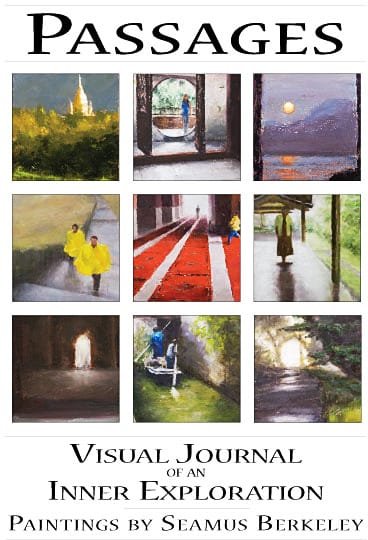
Passages

Note: The Passages show dates and times are here.

Letting Go
The Art of ‘Passages’

“The moment the eye opens up, all becomes equally fascinating, equally inspiring, equally pregnant with meaning.”
—Zen Seeing, Zen Drawing: Meditation in Action, by Frederick Franck

I’ve been painting for a long time.

My earliest recollection of drawing was at the age of seven when I drew a portrait of a man based on a book cover. It was a great likeness, really, and caught my whole family’s attention. It was a vividly memorable moment, even if I didn’t quite realize the importance of it at such an early age.

Since that time I have created all kinds of artwork: architectural renderings, theatrical paintings, and I’ve painted hundreds of people from all walks of life. I’ve traveled around the world studying the works of master painters, and since 2005 most of my time has been spent in Berkeley, California and Taos, New Mexico where I paint and offer workshops. During this time, I have been involved with a number of shows, including exhibitions at the RANE Gallery, the Fechin Inn, SomArts, Berkeley Open Studios and East Bay Pro Arts.

Life was good; still is in fact. I was actually making a living through my art, and isn’t that what it’s all about? Yet something was missing.

* *

Some time ago, I realized I was painting still lifes and landscapes just for the sake of painting them. I remembered that my intention all along was not just to paint nice pieces – even though they are. I just wanted something else in them.

Recently a dedicated private student asked me, “Where’s all your work?” This might seem like an odd question to the reader, but the truth is that despite having done hundreds of paintings, I’ve displayed relatively little of them. And somehow this student intuited that.

Maybe I was finally ready to unveil myself, so to speak, but her question rekindled the desire that I wanted a new element in my artwork. What element? I thought: Something that speaks to a different level of experience, a more inner place that is outside of simple vision or words, a place of pondering. Okay, but how could this be conveyed in the art?

I’ve always asked myself, “Why do I paint?” I address the question in my artist statement. One of my answers deals with discovery: the process of uncovering or revealing what was previously hidden. This practice entails connecting to an appreciation of beauty that we normally cover or gloss over in our day-to-day activities. I consider beauty to be a powerful inner experience, rather than an occurrence outside of oneself. Each individual has the potential to be in this experience of beauty; it is merely choosing to be present to the experience.

Anyway, this time I asked myself a different question. I wondered, “What do I paint?” And rather than think ahead to an imaginary setting or concept, I reflected back on the work I have already done and asked myself still another question: What of all those paintings spoke the clearest to express this idea of inner pondering?
Inner Sanctuary
It came to me immediately – the Inner Sanctuary pieces – one of the only times I have painted a scene twice. The setting for the painting was a cathedral in Ireland, the Rock of Cashel. There was something about looking through one doorway to another in the far distance where the light was pouring through that caught my eye. There was indeed the strength of the architecture, the repetition of the archways and contrast of light and dark that created a scene worth painting. And yet there was more, a little something indistinguishable and indescribable in the light – a little mystery that was better expressed visually than with a set of words.

That painting, I saw, spoke to the inner place I was thinking about, a place or notion that penetrates and conveys a deeper level of being. Einstein once remarked that the most beautiful and most profound experience is the sensation of the mystical. It is the source of all true science – and art too I should add.

So as I was pondering how to express this idea, the phrase ‘passages’ came to mind, alongside with images — of time, birth, death, transition, temporary, movement, travels around the world, relationships coming and going, every thing passing.

I had a clear moment – and I set out to paint. My series would be called “Passages.”

Usually when I paint, I listen to all kinds of music. This time, however, I worked largely in silence. Sometimes I’d listen to an audio of Eckhart Tolle’s Power of Now, where lines like “Many people are so imprisoned in their minds, that the beauty of nature does not really exist for them” would remind me of my purpose in painting – to be connected with the ongoing process of seeing beauty and the ever-changing kaleidoscope of life continuously unfolding.
Portal
As I created the series, “Passages,” it dawned on me that this time around, I wasn’t going to hide most of artwork. It was important to me that this series reflect an openness and exploration of looking at the world with new eyes. But it wasn’t just my eyes; it was everyone’s. My paintings, I felt, had a wide appeal, especially to those people who have an active contemplative practice.

But when you think about it, aren’t we all contemplative and active in one form or another?

It was time to come out.

* *

I’m a very private person. Since I was a child, growing up in three different countries, I never wanted to reveal what I valued or what was important to me. I was very smart in school, not interested at all in sports. As I became older, I always thought that most people were not interested in the things that loomed large in my mind: Inner exploration, understanding of life, myself, others, the world, the hidden meaning of everything. I felt that to show this would be too weird and lead to ridicule.

A journalist in Taos asked me, “Why would you think others didn’t think like you do, especially with all the ‘new age’ stuff around?” It was a good question, and I replied that it just went to show how insular a person I was – and still am to a large degree.

The idea of painting works to cover the dissonance of wanting to hide and wanting to be seen. I can make the work that expresses what is going on for me and people who see it never have to know me – the person who did it. I can remain anonymous. I remember when a piece of mine was in a show in Colorado and I was walking through and overheard a couple talking about my painting. (In this case, they were admiring the work!) It was one of the most fun times I had, standing there in their presence and they didn’t even know I did it! I was a fly on the wall, hiding in plain sight!

Well, not anymore. So much of an artist is a mystery to a customer, even in a gallery setting. There’s like this separation, this sense of being removed from each other. I want to break down this wall. And not just that wall but my personal wall.

The journalist I mentioned before asked, “This wall you built around yourself, are you now chipping away at it, or taking a sledgehammer to it?”
Portrait of the Artist as a Young Tagger
I answered that it was neither, that I’m going through it. There’s a sense of wonderment at crossing that barrier, but at the same time I feel a relief, a release. I’m acknowledging my talent, which is not easy, combining pride with humility, being able to share myself and proclaim, “Here I am.”

With “Passages,” I’ve discovered the thrilling paradox of my newer work having its roots in my older work. In a sense I’ve come full circle. The undercurrent of my life has become the main current.

I see now that while I may have wanted to erase personal history, I really wasn’t. It’s always been there. “Passages” is acknowledging that this is how it is, and actively accepting this notion is another way to say: Let go of the past because it really has gone. It’s about being in the power of now. Some might phrase it as, “Let go and let God.” That’s a good way to put it, I think. And it fits whatever spiritual path you follow. Substitute “nature” or “the universe” for God and you get the same result.

And letting go also equals activating your natural wisdom – your art if you will. That’s what
“Passages” is about. Quieting the mind and just taking time to see without words leads to a calm, deeper appreciation of creation and experiencing the awe of beauty.

Seamus Berkeley
Spring, 2009

Note: This essay/statement would not be possible with the writing and editing skills of David Pérez, the journalist from Taos I referred to. I highly recommend his services to any artist who wants to get their message (and themselves) across. David can be reached at dpereztaos@yahoo.com.